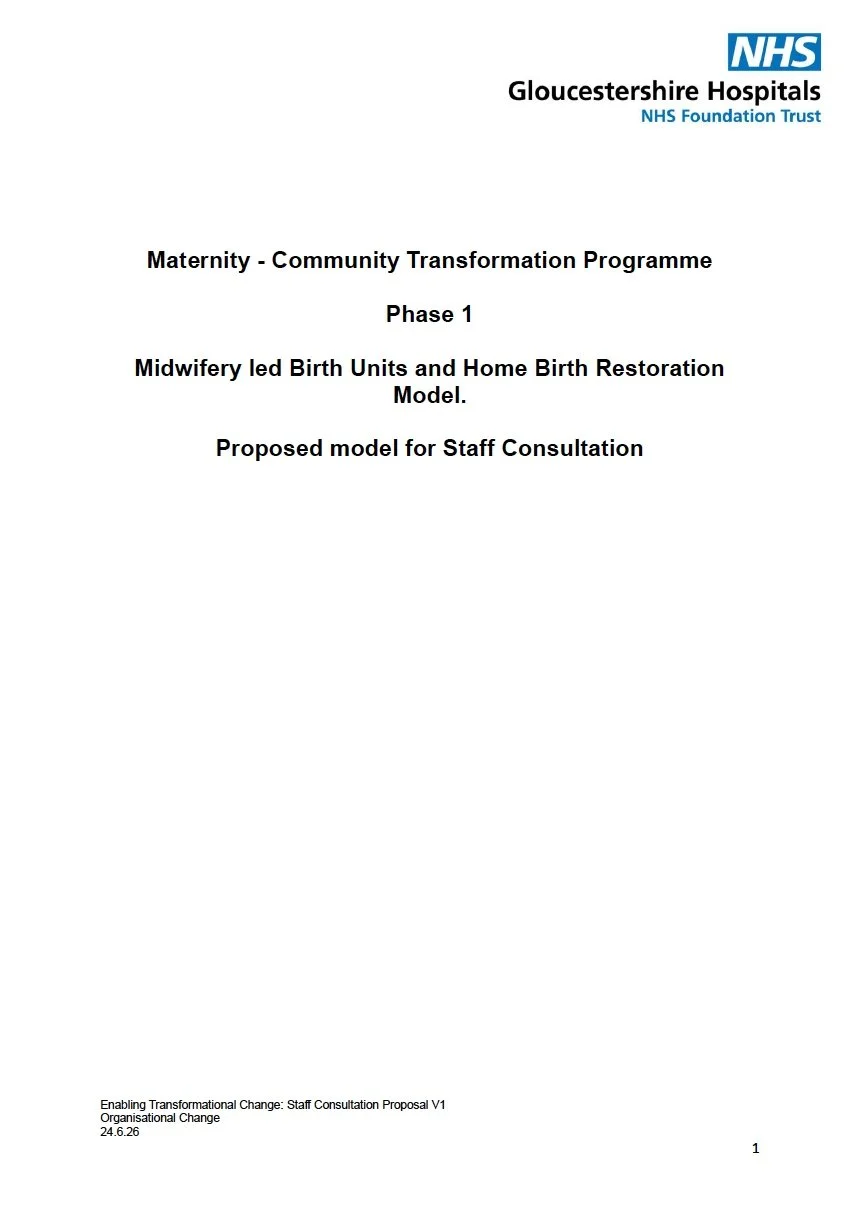
The document HOSC had been asking to see: what concerned us about the Community Birth proposal
Over the summer, a number of Gloucestershire midwives approached GMAG with serious concerns about the Trust’s proposed new Community Birth Team model.
They shared with us the staff consultation document that had been launched on 29 June 2026.
This was particularly significant because Gloucestershire’s Health Overview and Scrutiny Committee — HOSC — had been seeking sight of the proposal.
We were therefore grateful to receive a copy.
With support from colleagues at AIMS and Birthrights, we went through the document in detail, adding questions, comments and areas where we believed further evidence or explanation was urgently needed.
We then passed the document, together with our scrutiny notes, to HOSC.
And today, we are making it public.
Why were we so concerned?
Our first reaction was that this simply did not look like a robust document on which to base such a significant change to community maternity services.
It was poorly drafted in places, contained unanswered questions and assumptions, and made important claims without showing enough of the evidence behind them.
More importantly, the proposal appeared to have reached a conclusion before the consultation had even begun.
The document states that the Trust’s preferred option is a single county-wide Community Birth Team, operating 24/7 and able to support up to two simultaneous births. It then says the Trust is “seeking to progress Option 3.”
That immediately raised an obvious question:
What, exactly, was still open to consultation?
A consultation should happen while proposals are genuinely capable of changing.
But the options presented here were remarkably narrow:
continue with the existing temporary arrangements;
create a county-wide team able to support one birth;
create a county-wide team able to support two births.
There was no properly appraised locality-based option.
No small-team continuity model.
No model based around existing community midwives retaining intrapartum skills.
No independently commissioned provision.
No hybrid model.
The document simply says earlier work had been used to “narrow down” the viable options, without showing readers the full range of alternatives that had been considered and rejected.
That did not feel like an open consultation.
It felt worryingly close to a paper exercise around a preferred solution.
The reasons home birth was suspended are still there
This was perhaps our biggest concern.
The Trust’s own document says home birth support was suspended following concerns about:
inconsistent on-call cover, staff wellbeing and audit compliance.
It says home birth on-call cover had only been filled around half of the time and refers to repeated last-minute withdrawal of the service.
Elsewhere, it describes:
high community vacancies;
a workforce heavily weighted towards newly qualified midwives;
burnout and anxiety;
lone-working concerns;
fatigue;
staff feeling unsupported at home births;
inadequate senior oversight;
difficulties managing care outside local guidance.
These are serious issues.
But our question was simple:
How does moving those pressures into a new centralised team actually resolve them?
A new name and a new rota do not automatically create more experienced midwives, remove geography, prevent burnout, provide senior support or stop staff being redeployed elsewhere.
We wanted to see the evidence that those underlying problems had genuinely been solved.
Gloucestershire is a very big county
The proposed team would cover home births across the entire county, alongside births at Stroud and Cheltenham.
The model proposes three midwives on call 24/7, with escalation support from a Gloucester Birth Unit midwife, and capacity for up to two simultaneous births.
But where was the detailed geographical modelling?
What happens if one midwife is in the Forest of Dean, another is in the Cotswolds and another woman goes into labour in Stroud?
What happens when more than two women require support?
What happens in bad weather?
What are realistic travel times at night?
And how quickly can the Gloucester Birth Unit escalation midwife actually leave Gloucester if the unit itself is busy?
For a county as rural and geographically spread as Gloucestershire, these are not minor logistical questions.
They are safety questions.
Fragmentation worried us enormously
The proposal separates much of ordinary community midwifery from intrapartum community birth.
Under the proposed model, community midwives outside the Community Birth Team would no longer routinely provide intrapartum care at home births or MLUs. Instead, births would be attended by the separate Community Birth Team.
That risks creating a fragmented service in which the midwife arriving during labour may not be the midwife who knows the woman, understands her history, has discussed her birth plans or has visited her home.
Community birth safety is not simply about somebody turning up when contractions start.
Relationship matters.
Planning matters.
Knowing the woman matters.
Knowing the home, family circumstances, birth preferences and previous conversations matters.
Having senior support available when situations become complicated matters.
We were concerned that the proposed model could place midwives under pressure to attend women they did not know, in situations they had not helped plan for, sometimes without the continuity or senior backup they needed.
“Continuity” became increasingly confusing
The word continuity appears throughout discussions about the model, but we struggled to understand exactly what was meant by it.
Women booking for community birth would be caseloaded to the new team, with an anticipated caseload of around 40 women per midwife.
But the role description allocates a full-time Community Birth Team midwife around 100 hours each month to birth availability and only 50 hours to fixed community activity.
So how much meaningful antenatal and postnatal relationship could actually be built?
Would women know the midwife attending their birth?
Would the midwife attending understand the woman’s plans and previous conversations?
Was this actually continuity of carer — or a centralised birth rota with a caseload attached?
Those questions were never adequately answered for us.
Stroud: “open on demand”
The proposal says Stroud Maternity Unit would not close.
Instead, it would move to an “open on demand” model.
But that language needs unpacking.
An “open on demand” birth unit is not the same thing as a permanently staffed birth unit.
Who opens it?
Where are those staff coming from?
How quickly can they arrive?
What happens if those midwives are already attending a home birth elsewhere in the county?
What happens if demand exceeds the team's capacity?
Again, the practical detail matters far more than the reassurance contained in the phrase “Stroud is not closing.”
Gloucester Birth Unit is being used as the back-up
The model relies on a Gloucester Birth Unit midwife providing escalation support to the Community Birth Team.
The document says that midwife must remain ready to respond to community escalation and should not provide one-to-one intrapartum care during those support shifts.
But staff had already been telling us about pressures and redeployment within the wider service.
So we wanted to know:
Is this escalation midwife genuinely protected?
Because an escalation system is only useful if the person you are relying on is actually available when you need them.
Impact assessments were not finished
The document says the Equality Impact Assessment and Quality Impact Assessment were still “underway” and would be shared before the end of the consultation.
That concerned us.
Surely equality and quality implications should form part of the information people use when deciding whether a proposed service model is appropriate — particularly where rural access, women’s place-of-birth choices and major workforce changes are involved.
Even the financial picture was unfinished
The proposed staffing table records the budget impact as “TBC.”
Yet the document repeatedly describes the preferred option as the most sustainable and deliverable model.
We wanted to understand:
What would it cost?
How did that compare with the alternatives?
What resources would actually be needed to make it work safely?
Without that information, how could anybody meaningfully compare options?
Recruitment was another major dependency
The proposal itself says implementation depended on recruitment to the Community Birth Team, training, leadership arrangements and other practical requirements.
And yet staffing fragility was one of the very problems the transformation programme was supposed to solve.
That felt circular.
If there were not enough experienced midwives willing or able to join the new team, what happened then?
Would Stroud still lose its existing staffing model?
Would home birth remain suspended?
Would staff be moved?
Would the model be reconsidered?
These were questions that needed clear answers before implementation — not afterwards.
Why we sent this to HOSC
HOSC exists to scrutinise significant decisions affecting local health services.
When we received this document, we believed councillors needed to see it.
We sent HOSC the consultation proposal with our detailed notes and questions, covering the evidence base, options appraisal, workforce assumptions, continuity, governance, finance, implementation and the consultation process itself. HOSC subsequently asked the Trust to provide a written response to the questions and comments GMAG had raised.
The Trust later responded that this was an internal staff consultation document rather than a public-facing options appraisal and declined to provide detailed answers to many of those wider questions.
That only deepened our concern.
If questions about the model of care were outside the scope of the staff consultation, where were those questions actually being consulted upon?
And if HOSC — the county's statutory health scrutiny body — was asking questions about a significant redesign of maternity provision, why weren't those questions being fully answered?
Read it for yourself
We don't expect everyone to agree with our interpretation.
That is precisely why we are publishing the documents.
Read the original proposal.
Read our notes.
Look at what information was available at the beginning of the consultation and what was still missing.
Ask whether you think the options were genuinely open.
Ask whether the proposed model addressed the problems that caused home birth support to be suspended.
And ask whether this looks like meaningful consultation on the future of community birth in Gloucestershire — or consultation around a direction that had substantially already been decided.
This is the first document in our series.
Next, we will publish GMAG's alternative proposals, developed with support from colleagues at AIMS and Birthrights.
After that, we will share the response submitted by frontline midwives.
And finally, we will publish the Trust's consultation outcome.
We think Gloucestershire families deserve to see the whole process for themselves.