
A Case for Change - Key Problems
Gloucestershire NHS Trust have spent the last 6 months waiting for this document to be produced but reads more like a high-level slide deck of assumptions than a serious evidence base for major maternity transformation.
Join our panel discussion to create a formal critique and proper case to be made.
To join our panel discussion Tuesday 9th July 1pm email HERE
To support this work and our wider advocacy with a monthly membership donation click HERE
Page 1
This page says the Case for Change sets out why services need to change, does not propose solutions, but provides the foundation for redesign. It then claims the document has been “coproduced” with colleagues across the system, including the MNVP, and says the reasons for change are increasing clinical complexity, workforce pressures, changing choices and expectations, national policy/reviews, and the statement that the current model is “not fit for the future.”
Let’s look at each statement 1 at a time…
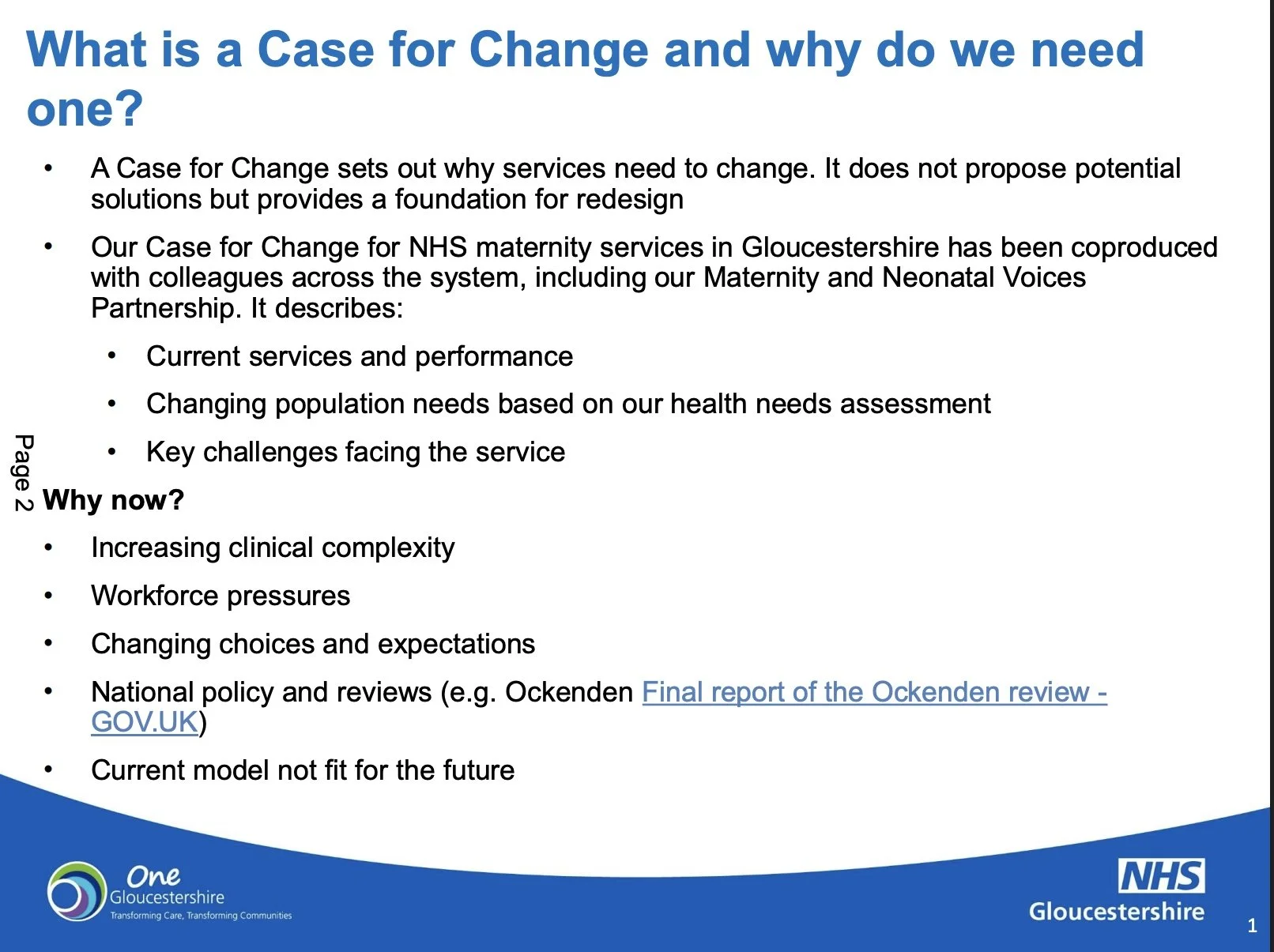
“A Case for Change sets out why services need to change.”
This is fair as a definition, but the document then fails to meet its own test.
It gives broad themes rather than a properly evidenced explanation of why this particular direction of travel is needed.
A true case for change should show detailed evidence, options, risks, alternatives, equality impacts, district-level need, service-user impact, and consequences of doing nothing.
“It does not propose potential solutions but provides a foundation for redesign.”
This sounds neutral, but in context it is not neutral.
The wider HOSC paper already moves straight into a proposed Community Birth Team, open-on-demand Stroud/Cheltenham model, and centralised deployment approach.
So the “Case for Change” is being presented as neutral groundwork while sitting alongside a direction that appears already chosen.
“Coproduced with colleagues across the system, including our Maternity and Neonatal Voices Partnership.”
This is a major unsupported claim.
We do not know who was involved, when they were involved, what evidence was gathered, what women said, what staff said, what changed because of their input, or whether dissenting voices were included.
“Including the MNVP” is not the same as meaningful coproduction.
“It describes current services and performance.”
Page 1 claims the document describes service performance, but the Case for Change does not appear to provide enough performance data to allow scrutiny.
It does not properly analyse place-of-birth preference, intended versus actual birth location, transfers, closures, suspensions, staffing gaps, district-level access, complaints, BBAs, freebirth concerns, or postnatal impacts.
“Changing population needs based on our health needs assessment.”
The document uses population-level demographic statements, but does not break need down properly by district.
That is a serious flaw in Gloucestershire, where the Forest of Dean, Gloucester, Stroud, Cheltenham, Tewkesbury and the Cotswolds have very different geography, transport issues, deprivation patterns, birth options, and access barriers.
“Increasing clinical complexity.”
This may be true in part, but the statement is used without enough explanation.
It does not separate women who genuinely need consultant-led care from women who would benefit from protected midwifery-led care.
It also risks implying that more complexity equals less community birth, when continuity and community-based care can be part of reducing risk and pressure.
“Workforce pressures.”
Workforce pressure is real, but the page does not ask why those pressures exist.
There is no analysis here of leadership, retention, sickness, bullying/culture, lack of continuity models, loss of experienced community midwives, failed recruitment, poor workforce planning, or the consequences of repeatedly suspending services.
“Changing choices and expectations.”
This is very vague.
What choices?
Whose expectations?
Women choosing home birth?
Women wanting continuity?
Women wanting local care?
Women wanting more postnatal support?
Without evidence, this phrase can be used to suggest women’s preferences are part of the problem rather than something services are legally and ethically required to respond to.
“National policy and reviews, e.g. Ockenden.”
National reports should not be used as a vague backdrop to justify local centralisation.
Ockenden and other maternity reviews repeatedly point to listening to women, safe staffing, culture, personalised care, escalation, training, governance and accountability.
They do not automatically justify reducing local community provision or replacing staffed local units with locked buildings opened on demand.
“Current model not fit for the future.”
This is the strongest unsupported statement on the page.
Which model?
Home birth?
Stroud?
Cheltenham?
Community midwifery?
The previous on-call model?
The whole Gloucestershire maternity system?
The statement is too broad and lacks evidence.
It risks condemning community maternity care as a whole, when the failure may actually be leadership, staffing, investment and governance.