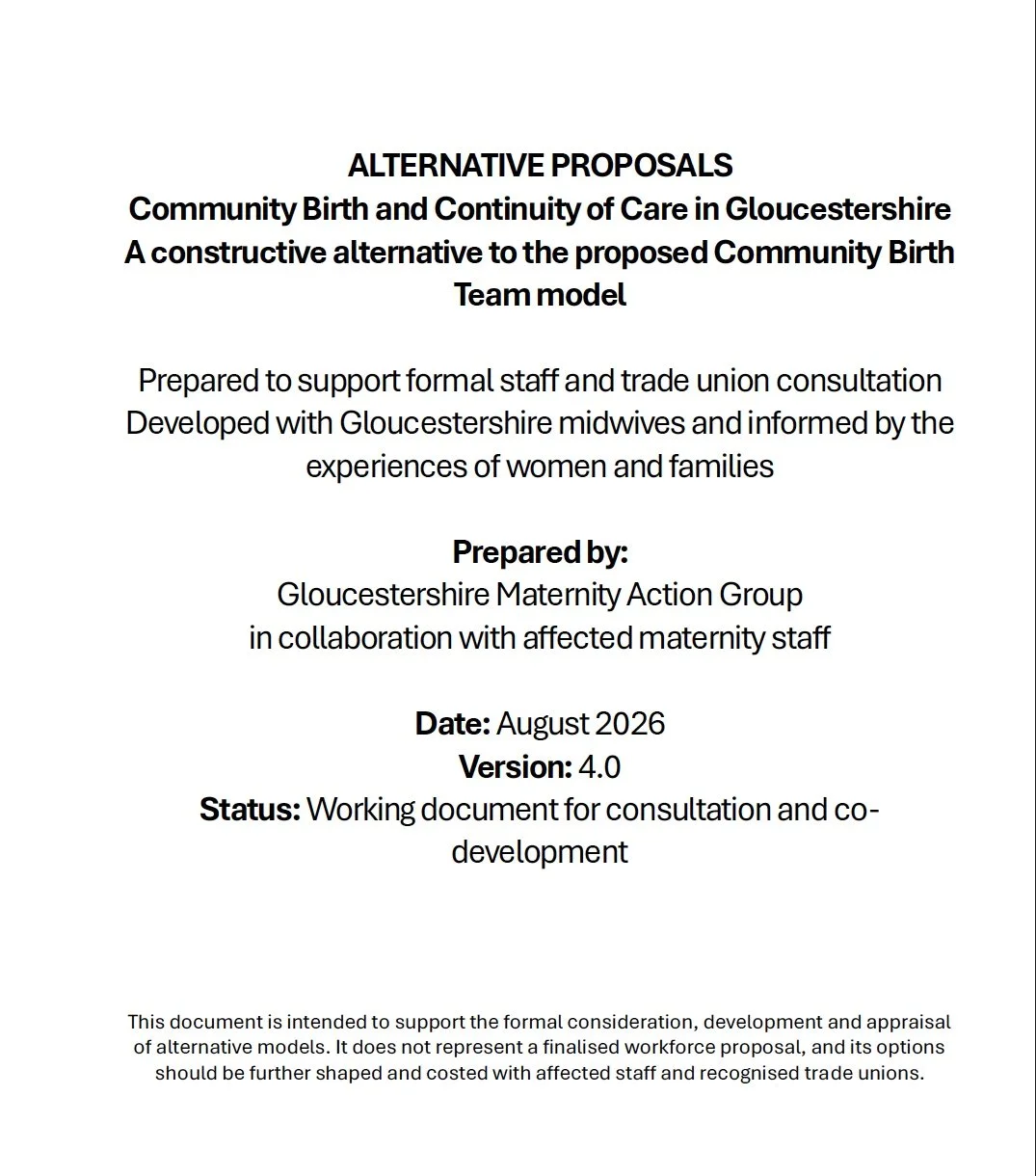
Document 2: GMAG’s alternative proposals for restoring community birth in Gloucestershire
The second document we are sharing is GMAG’s alternative proposals for restoring community birth in Gloucestershire.
This document was developed with support from colleagues at AIMS and Birthrights, and was written in response to the Trust’s proposed Community Birth Team model.
GMAG is not opposing the restoration of home birth or community birth.
Quite the opposite.
We have consistently called for the urgent restoration of home birth support, the protection of Stroud Maternity Unit, the reopening of Cheltenham birth provision, and the rebuilding of safe, local, relationship-based maternity care across Gloucestershire.
But restoration must be meaningful.
It must be safe.
It must be sustainable.
It must work for women, babies, families and midwives.
And it must not simply carry forward the same pressures that led to the suspension of home birth support in the first place.
We put forward real workable alternatives which must be considered
One of the most frustrating parts of this process has been the trust is only considering one option.
Centralisation or stay closed.
This is not true consultation.
GMAG’s alternative proposals set out other ways of restoring community birth support that would better protect locality, continuity, planning, staffing resilience and women’s choice.
The Trust’s proposed model is a centralised county-wide Community Birth Team.
Our concern is that a single centralised team creates a fragile service: stretched across a large rural county, dependent on escalation from already pressured services, and vulnerable to redeployment, burnout and fragmentation.
Community birth is not just about whether a midwife can physically arrive when labour begins.
It is about relationship, preparation, local knowledge, planning, senior support, clear escalation and trust.
The alternative models we asked the Trust to consider
GMAG’s document set out a range of alternative models that could be properly developed, costed, risk assessed and compared against the Trust’s preferred option.
These included:
1. Strengthened locality-based community teams
Under this model, community midwives would retain antenatal, intrapartum (birth) and postnatal practice, with designated home birth and midwife-led birth capacity in each locality.
This would protect the skills and relationships that already exist within local community teams, rather than removing birth from most community midwives and placing it into one county-wide team.
It would also support local knowledge, shorter travel distances, better planning, and a stronger connection between pregnancy care and birth care.
2. Community Birth Champions within local teams
This model would identify experienced midwives within each locality to provide leadership, mentorship and escalation support.
Rather than concentrating all community birth knowledge into one small specialist team, this approach would help maintain and grow community birth skills across the wider workforce.
It recognises that the answer to skill gaps is not to remove birth from community midwifery.
The answer is training, mentorship, support and protected experience.
3. Local continuity teams with county-wide mutual aid
This option would create small locality-based continuity teams, with county-wide back-up when needed for simultaneous births, sickness, leave or surges in demand.
This model would protect the benefits of relationship-based care while still recognising the need for resilience across the county.
It would allow women to be cared for by smaller teams who know them, while also creating mutual aid arrangements so that no locality is left isolated.
4. A Gloucestershire adaptation of the Albany model
The Albany Midwifery Practice is often discussed because it showed what can be possible when small groups of midwives are trusted to provide genuine continuity across pregnancy, birth and the postnatal period.
GMAG suggest using the Albany’s core principles — relational continuity, local practice, professional autonomy, whole-pathway care and collective responsibility.
The Albany showed that midwives and women thrive when care is relational, skilled, autonomous and rooted in trust.
5. Hybrid NHS and independently commissioned provision
This option recognised the urgent need to restore home birth support while longer-term NHS provision is properly developed.
It proposed that local NHS teams remain the permanent model, while temporary independent midwifery capacity could be commissioned to restore home birth immediately and support training during transition.
This matters because families should not be left without home birth support while the system debates and restructures.
Temporary commissioned provision could help bridge the gap, protect women’s choices, and reduce pressure on NHS teams while a safer long-term model is built.
These options should be appraised fairly before ploughing forwards with a single central team model that midwives do not want.
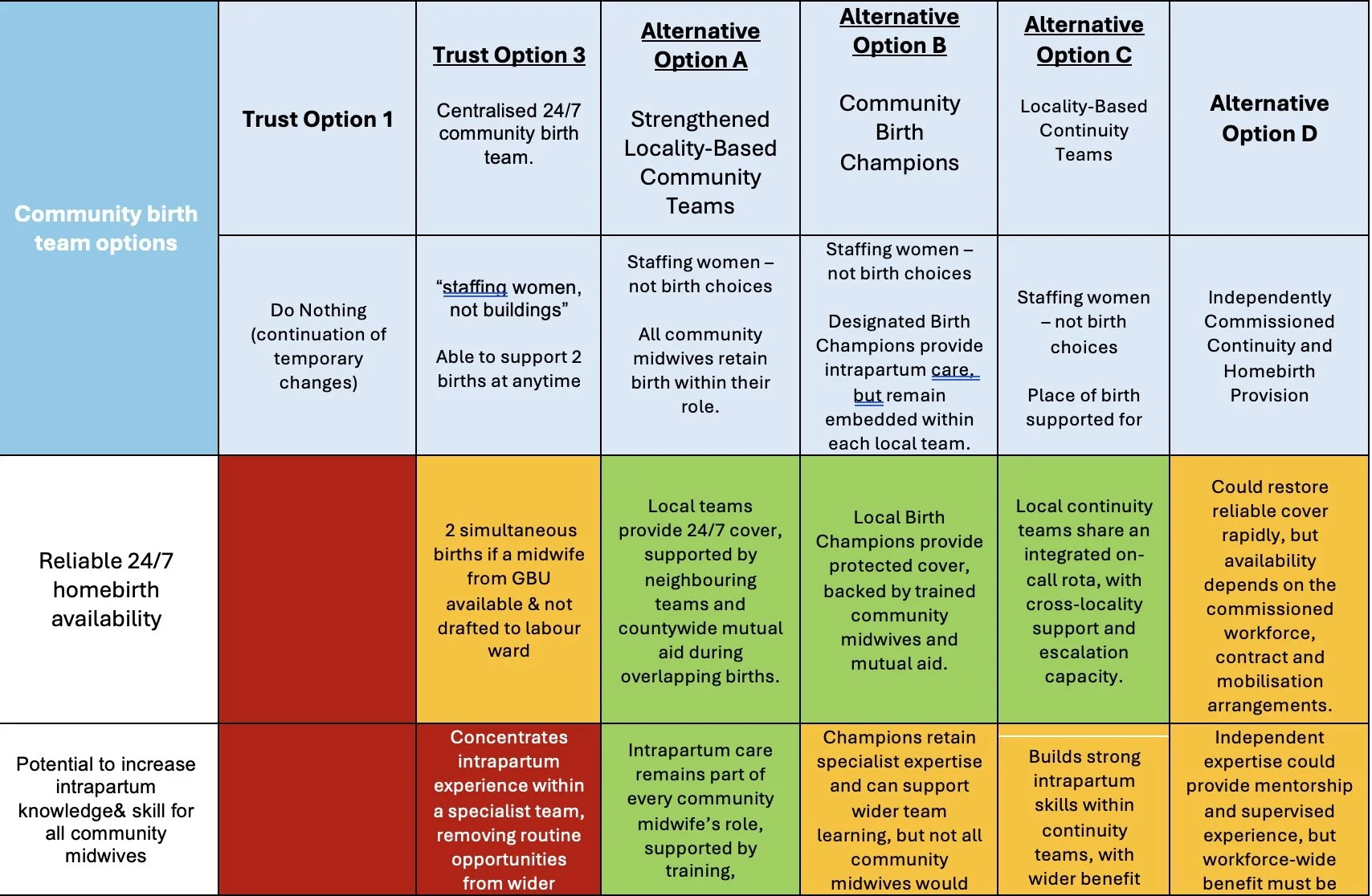
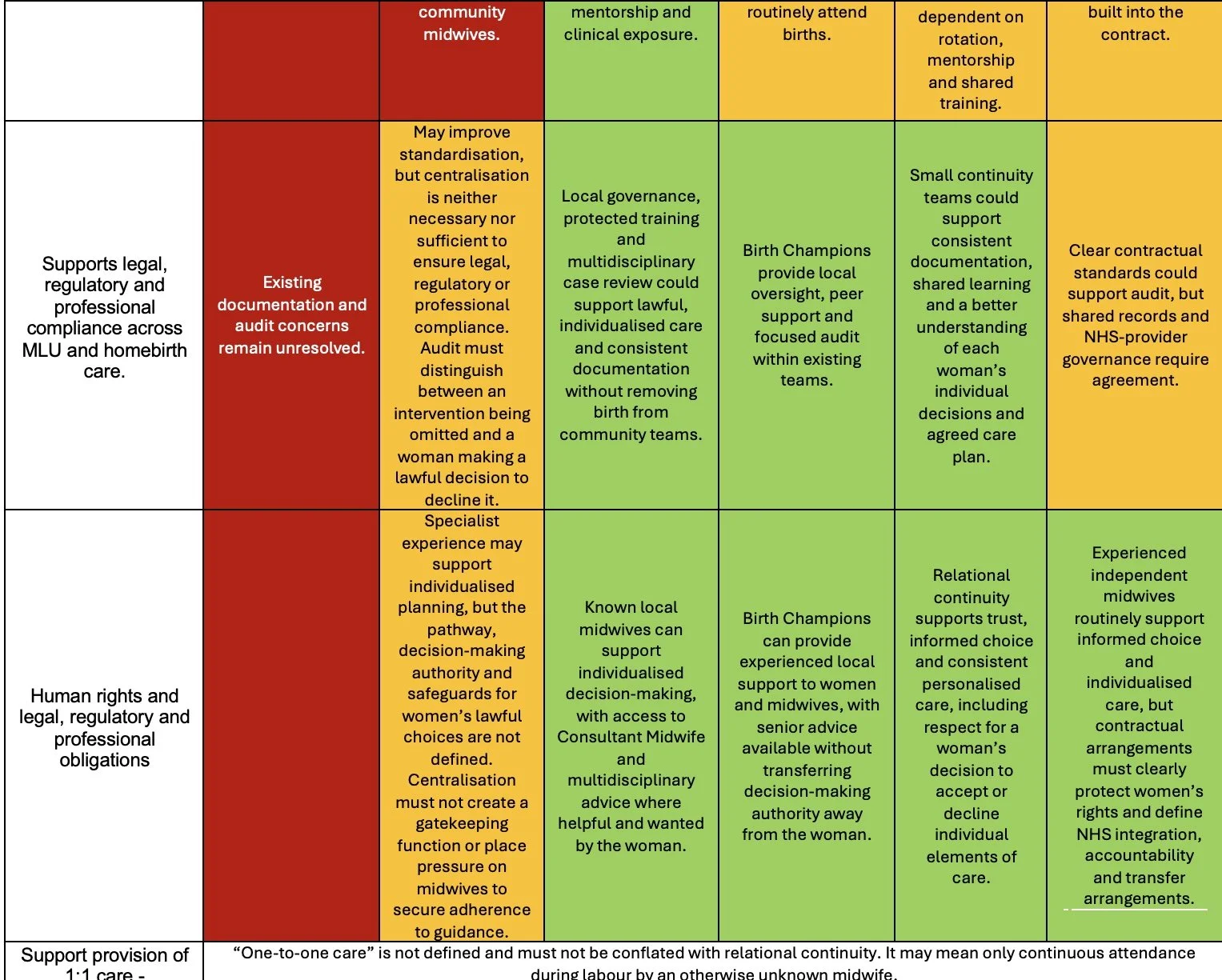
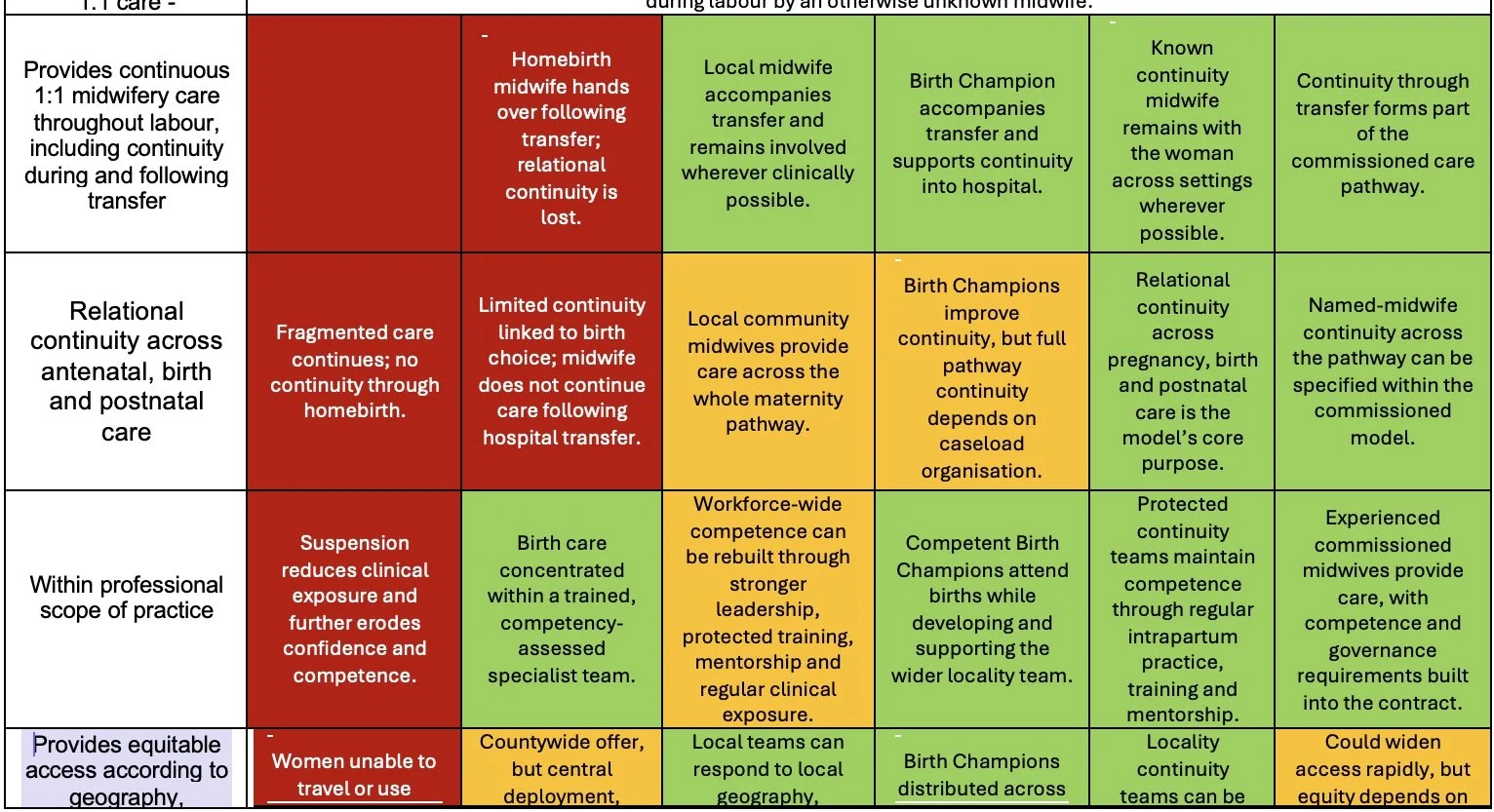
The following table provides an overview of the Trust’s proposed centralised Community Birth Team and Alternative Models A–D. It compares each model against the key principles and practical requirements identified throughout this counterproposal, including continuity, capacity, locality, workforce sustainability, women’s choice and access to community birth.
The table uses a RAG rating to make the strengths, limitations and areas of uncertainty visible:
Green: criterion met or a clear strength of the model
Amber: partly met, dependent upon implementation, or further assurance required
Red: criterion not met or a significant concern identified
Grey: insufficient information currently available to assess
The ratings are accompanied by short comments and should be read alongside the fuller explanation of each model in the sections that follow.
They are intended to support transparent comparison and further appraisal—not to replace detailed workforce, safety, equality and financial modelling.
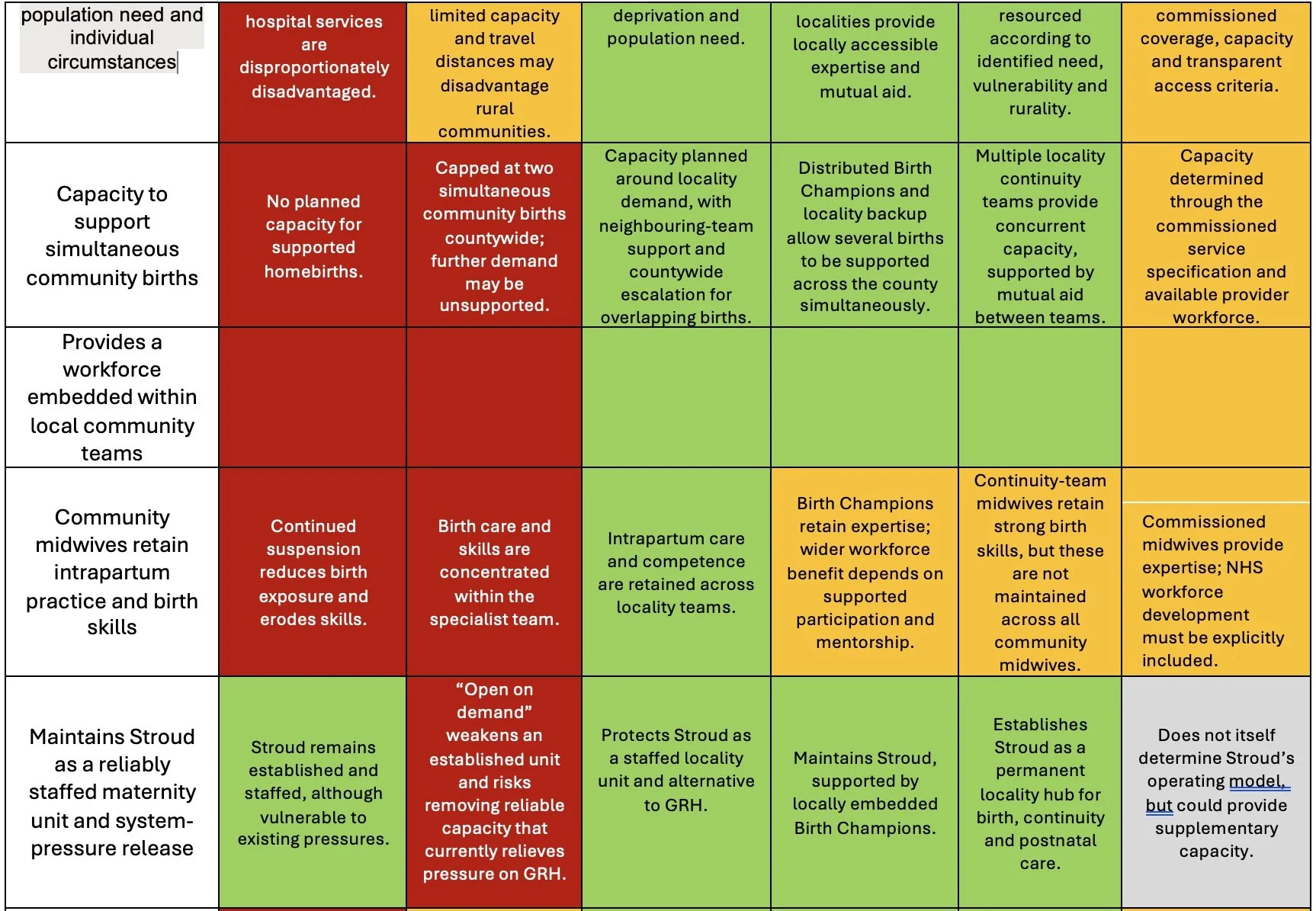
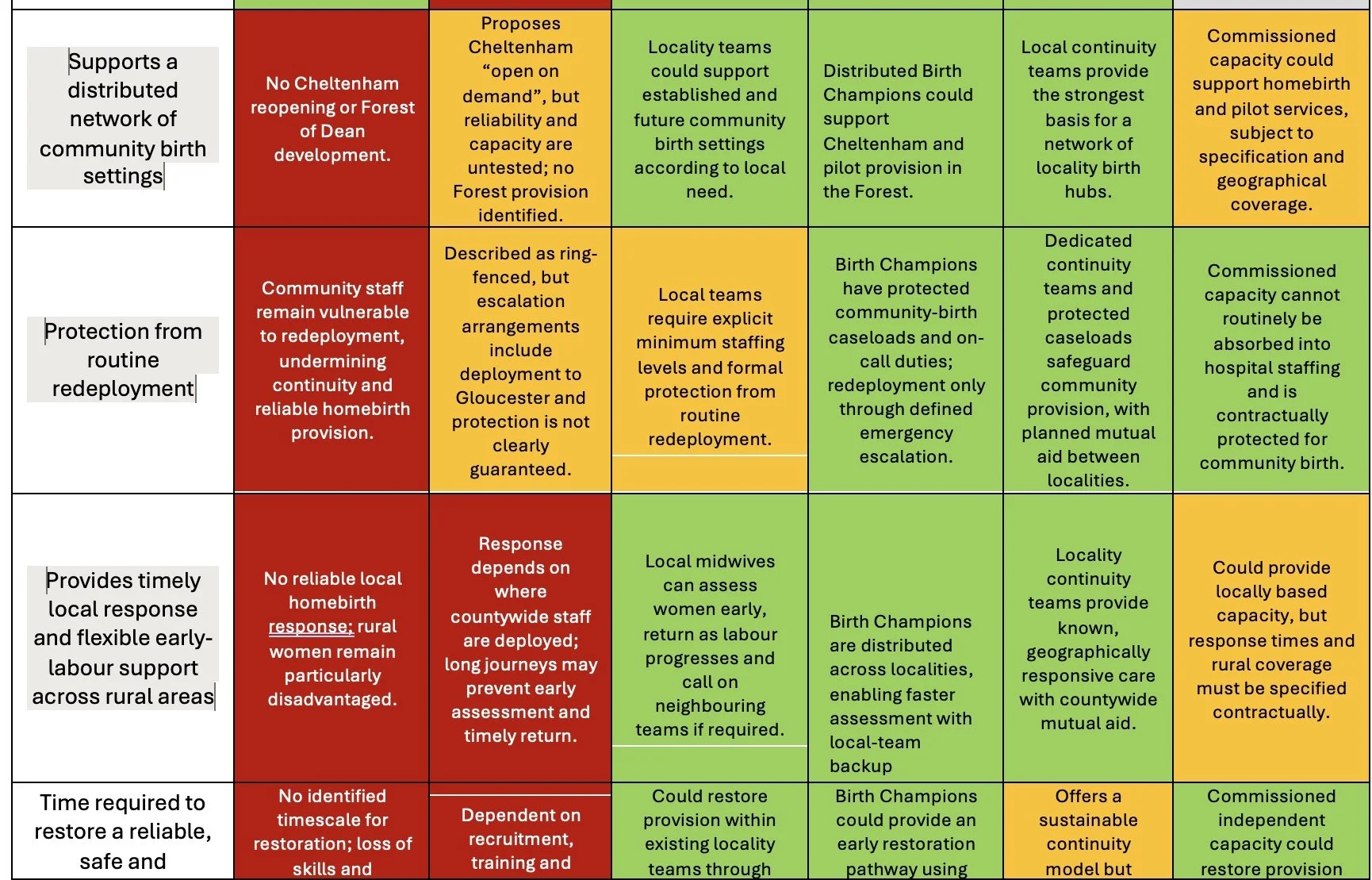
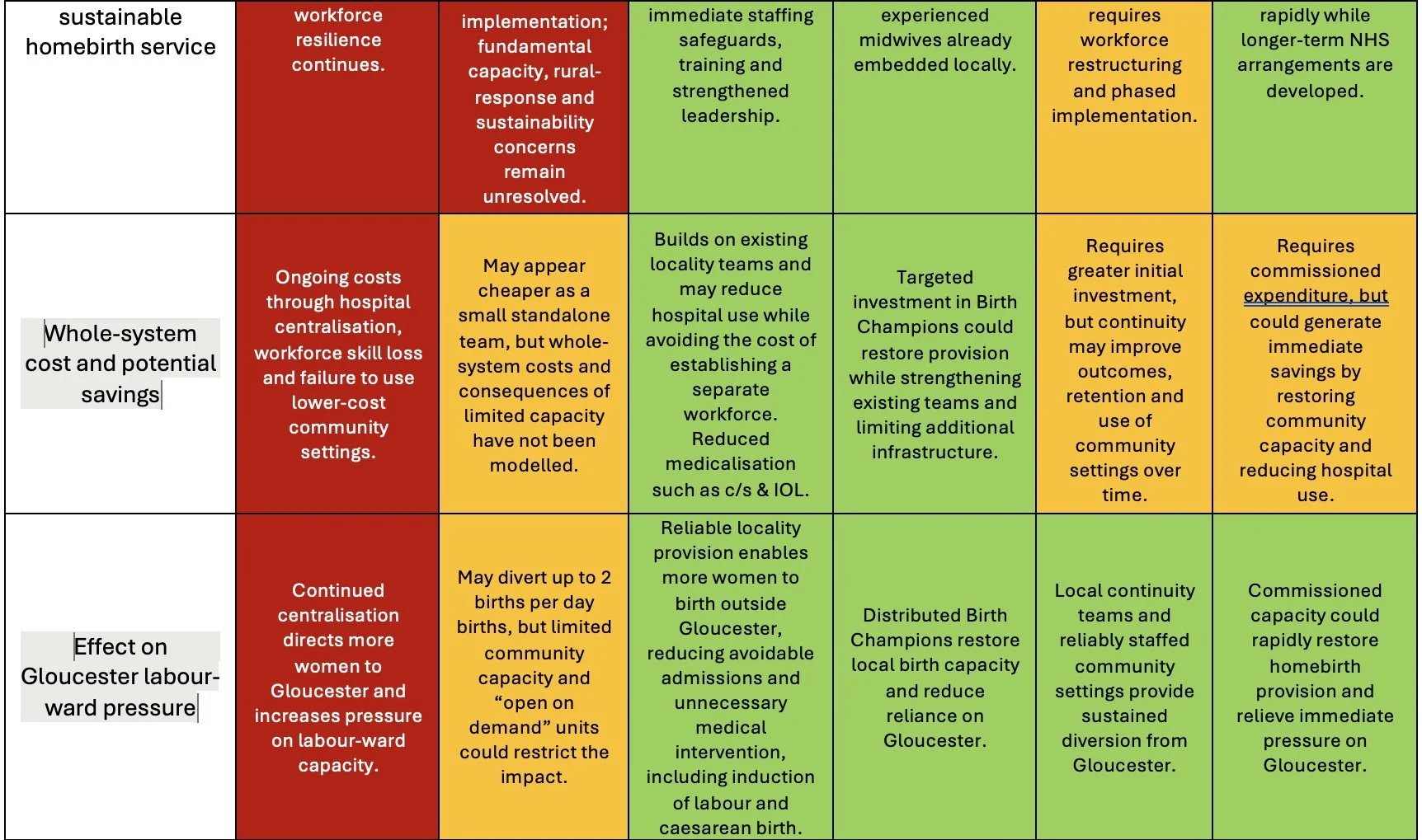
Cost appraisal must consider the entire maternity pathway, not merely the staffing cost of the community-birth team. This should include the effect on hospital admissions and capacity, intervention and transfer rates, workforce retention and sickness, recruitment and training, use of existing community facilities, and the financial consequences of adverse outcomes.
The Trust’s preferred model should never have been treated as the default answer.
If the Trust believes its centralised county-wide model is the safest and most sustainable option, then it should be able to demonstrate that through a transparent comparison with credible alternatives.
We are sharing the full document
Here we are sharing GMAG’s full alternative proposals document.
We are doing this openly because serious questions remain unanswered.
The Trust has described its public process as “engagement” rather than consultation, yet meaningful public engagement has still not taken place. At the same time, plans appear to be moving forward, including recruitment for the new Community Birth Team.
We understand that no existing midwives have chosen to join the proposed team, and that the Trust is now advertising externally.
That raises even more questions.
How can a new model be recruited for before it has been properly scrutinised?
How can permanent or semi-permanent changes be progressed before women, families, midwives and local communities have been meaningfully involved?
How can the Trust claim this is the safest and most sustainable model without first publishing a full comparison with the alternatives?
Over the coming days, we will continue to break this document down into smaller, more accessible sections.
We are also asking for support in challenging the Trust and demanding that our public bodies act as public bodies should: with transparency, accountability, evidence, and women’s health at the centre.
It is not good enough to say that other Trusts have high caesarean rates too, or that women are more complex - complex women need good community midwifery teams and high levels of continuity.
It is not good enough to say this is the only option when alternatives have not been properly appraised.
It is not good enough to ask women, babies and midwives to accept a fragile model because the system has failed to build something better.
Birth is not a minor service.
Being born happens only once.
The way birth unfolds can have lifelong consequences for the baby, and lasting physical, emotional and psychological consequences for the mother.
Maternity services shape families, communities and future health.
That is why this matters.
We need safe, local, compassionate, properly staffed community maternity care in Gloucestershire.
And we need it to be built transparently, with women, families and midwives genuinely heard.